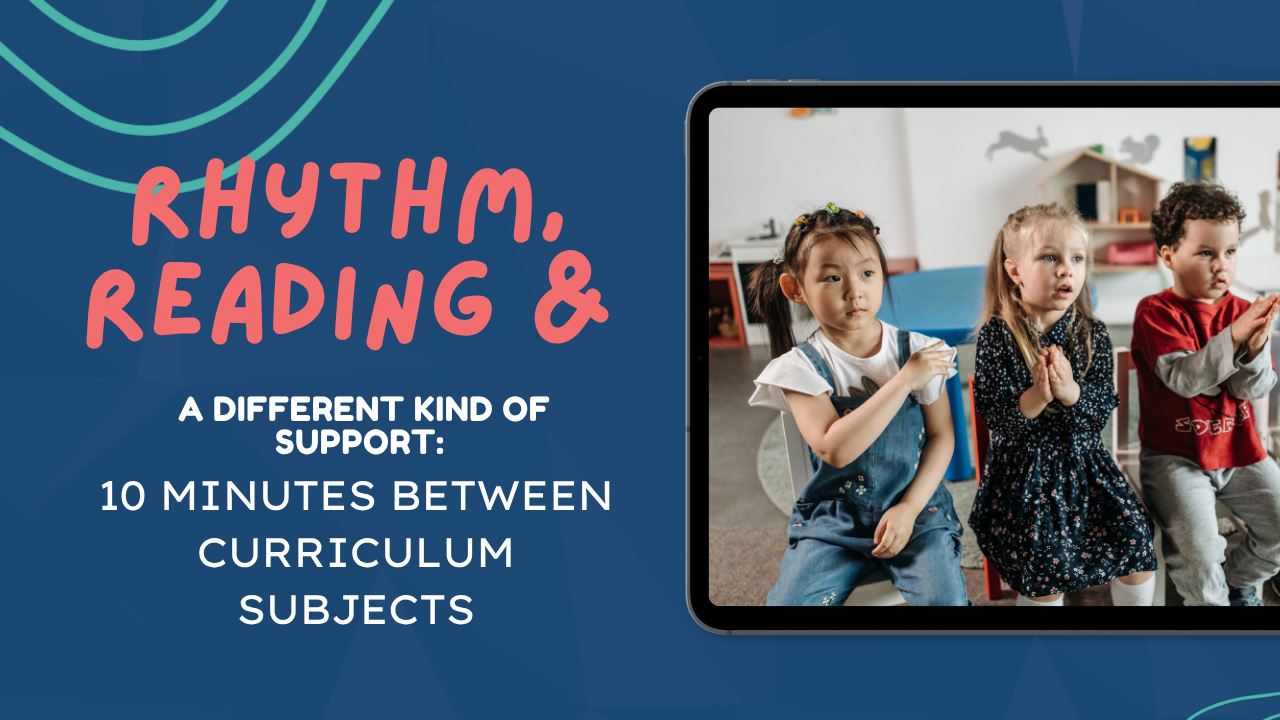
A Different Kind of Support: 10 minutes between curriculum subjects
“I’m on a different level of reading, and also I changed groups in English, Maths, Geography and History. I have been getting a lot of Golden Tickets.” (Year 3 child, after 10 weeks)
When I interviewed headteachers and teachers as part of a national pilot, it was obvious that children who spent time out of class for reading support were missing important curriculum time. The amount of time they missed was a real concern for their teachers and senior leaders and it made sense to me. Support does not have to mean that children come out of class for long stretches of time, and miss important parts of the curriculum on a regular basis.
What time out of class can cost lower-attaining readers
When lower-attaining readers spend time out of class for reading support, they can become disadvantaged all over again. They miss out on vocabulary, concepts, opportunities to ask questions and to join in with activities. Of course reading support matters, but so does vocabulary, oracy, taking part and broadening their perspective more generally. With the Curriculum and Assessment Review recommending a new oracy framework, time in the classroom to build spoken language matters more than ever.
When support is timed to protect a child’s access to the curriculum, and to prioritise their participation in shared moments such as assemblies, sport and the performing arts, the benefit can reach well beyond reading. Children can see and feel it in their learning across all subjects. However, when many pupils need this kind of support it can be difficult to find the resources and to implement them at scale, in part because there are few moments when children can come out of the classroom without being disadvantaged in some way.
Reading well is essential for accessing the wider curriculum. Learning to read well in primary school is foundational not only academically but also for the way each child can see their own future. I have written before about an eight-year old, who had been very concerned about how they would cope in Year 4 and every year after that, as they knew they were not keeping up in Year 3.
Children develop at different rates and ages. But according to some researchers, lower-attaining readers were likely to lag further behind in terms of progress, whereas proficient readers would make progress, through reading more.
The so-called ‘Matthew effects’ have been cited for almost sixty years, beginning first with Merton (1968) who referenced the parable of the talents to describe how recognition accumulates in science. Stanovich (1986) applied the idea to reading. The concept remains current, but when Pfost and colleagues (2014) reviewed 25 years of research, they found no strong support for a general pattern of gaps that widened or narrowed. They found, however, that the reliability of the reading assessments used by researchers and the type of reading skills that they measured varied. The Matthew effects were more likely to be present if researchers had used the types of reading test that measured decoding efficiency or vocabulary, particularly when the tests themselves were more reliable.
Three types of trajectory in primary education were identified (Pfost, 2014).
The lower-attaining readers fall further behind (the gap between them and their classmates widens)
The lower-attaining readers catch up (the gap narrows)
The lower-attaining readers improve at the same rate as everyone else (the gap stays the same)
The third type seemed to be the most likely to occur in schools, but they urged caution as there were so many limitations on the reliability of the studies included in their review. Whatever pattern a child follows, time out of class has a cost. An intervention that keeps that time to a minimum is worth considering.
What a ten-minute reading intervention looks like
Ten minutes doesn’t sound very long. On the other hand, when a secondary school had used Rhythm for Reading and seen the effects of weekly ten-minute sessions, they started teaching intensively in ten-minute bursts before school as part of a catch-up initiative for Year 9 pupils and were pleased with the impact.
Ten minutes is more than enough time when we are working on one specific task - particularly an embodied task. Imagine learning to operate a rowing machine at the gym. Getting to know the layout, the weights, the settings and how to operate the moving parts takes a short while, probably less than ten minutes, and after a few weekly sessions, these new skills become second nature and begin to flow.
The coordination between rhythm-based movement and fluent reading of simple musical notation is very similar. Just as a rowing machine involves rhythm, flow and spatial awareness, so too do reading music and moving in time. There are a few basic concepts and a few basic moves and we practise coordinating these in just ten minutes a week. The simplicity of the programme is key because it’s been designed for ease of use by non-specialist musicians and lower-attaining readers, perhaps during breaks between curriculum subjects.
Ten minutes of full attention: why short sessions suit lower-attaining readers
For me, the more interesting aspect of the ten-minute session duration is that it feels very different, depending on whether the activity can be experienced with ease. A proficient reader may say that ten minutes is not long enough to learn something new, and this is understandable because it’s quite frustrating to start reading a book, only to put it down again after ten minutes.
On the other hand, for a lower-attaining reader, ten minutes spent reading print is arduous, laborious and rarely rewarding. This time drags; even one minute spent reading can feel tiring. The main difference is ease and ease is achieved through motion rather than by remaining static.
Proficient readers are poised as they read because the activity of reading is dynamic and multilayered. For them automaticity took care of the coordination of the dynamic aspects of reading. When automaticity doesn’t ‘click’ into place, we can guide lower-attaining readers towards ease, fluency and understanding by using shared rhythm as a scaffold to build attention through moving and reading as a group.
When a child chooses to read at home
“I’ve noticed that I start to read better, because when I go home, I want to just start reading. I used to just watch TV.” (Year 3 child)
Imagine for a moment how it might feel to realise that your friends are reading chapter books, whereas you are still trying to blend letters into words and words into phrases. You have no idea how this gap between you all has appeared as if out of the blue, but it’s quite alarming and you wonder why you seem different in such a fundamental way. Catching up seems impossible. This isn’t like running a race where trying harder will make a difference. No matter how hard you try, reading is always the same and it doesn’t get easier. Until one day, you realise that reading is no longer difficult. The words are flowing and they are interesting. They fly off the page into your head and create images in your mind. You are entranced. You are 'off the hook' and thrilled to be just like your friends again. Of course you want to read instead of watching TV.
A feeling of relief can be accompanied by a release of shame or anxiety or guilt or other heavy emotions. Some children imagine they are fundamentally flawed, and are delighted when they can move past these fears. They are aware that they have moved from one ‘trajectory’ to another (though they would not use this word). They would explain what’s happened in terms of moving up into a new group or onto a new level and mention the changes in their learning that ripple out beyond reading into the wider curriculum.
Building reading expertise in your own team
I created Rhythm for Reading CPD as an online programme so that schools and teachers would be able to access the rhythm-based approach to supporting lower-attaining readers, no matter their location or budget. The quality of the training is my top priority. I see no point in creating something that doesn’t make a difference. This is why the programme is 30 weeks long and runs for three terms. The time invested decreases as teachers become familiar with the resources. In term one, they allow 30 minutes per week, in term two, the training takes up 20 minutes per week and in term three, it’s ten minutes per week. There’s also a short weekly check-in call, so that learning is supported and tailored to each school setting.
At the end of the 30 weeks, Rhythm for Reading can be embedded into the work of the school and sustained by the school’s own team.
Alongside phonics, not instead of it
Headteachers who have had Rhythm for Reading in their school say that it extends and supplements the phonics programme that is in place. There’s no doubt in my mind that phonics is necessary and I am delighted to see children apply their phonics skills with confidence in early reading.
For many children, phonics opens the way to fluency. For some, automaticity, ease and comprehension need further support. Rhythm offers the support for lower-attaining readers who are at risk of not being able to access the curriculum and of feeling left behind.
Is Rhythm for Reading right for your school?
If, like me, you are passionate about making a difference and helping children to learn to read well, I have created something new. It’s based on what I’ve learned from delivering Rhythm for Reading in schools since 2012. If you are interested in finding out a little bit more about this, it’s a mini-course which outlines exactly what is required to deliver the programme well in a school.
You can access ‘Rhythm for Reading: 5-Day Implementation Plan’ here Launch price: £7.99.
FAQs
How much staff time does it take?
Once a teacher has completed the 30-week CPD course, it takes only ten minutes a week to deliver the ten-week programme to pupils and a further five minutes to reflect, record progress and plan the next session using the universal Rhythm for Reading Session Planner.
Who delivers it?
A teacher delivers the Rhythm for Reading programme to a small group of pupils. They do not need to have prior musical training or knowledge, but they do need to feel at ease with moving to music and encouraging pupils to follow their lead.
Does it replace a phonics intervention?
No. Rhythm for Reading extends and supplements the phonics programme that is already in place in a school.
What evidence is there?
My five years of doctoral research at UCL Institute of Education involved six experimental studies in key stage two. Four of the studies used control groups and the final two studies simply explored whether a rhythm-based approach could be effective when delivered in a school by a teacher. The first three experiments showed that when compared with a control group (who simply took part in their usual curriculum music lesson), the rhythm-based group improved in reading comprehension score to a statistically significant extent. Lower-attaining readers made more progress than other children who had taken part in the rhythm-based intervention. This same finding came up in three different primary schools. In experiment four, two groups of lower-attaining children took part. One group took part in the rhythm-based intervention. The other group took part in a multi-sensory phonics training. Then after six weeks, both groups swapped intervention. This work was done before phonics was taught in all schools in England. The findings showed that taking part in phonics improved word accuracy and taking part in rhythm improved reading comprehension. Since then, the approach has been featured in peer-reviewed journals (Long, 2014; Hallam, 2019). I will give a fuller account in a later post.
REFERENCES
Hallam, S. (2019). Can a rhythmic intervention support reading development in poor readers? Psychology of Music, 47, 722–735.
Long, M. (2014). ‘I can read further and there’s more meaning while I read’: An exploratory study investigating the impact of a rhythm-based music intervention on children’s reading. Research Studies in Music Education, 36(1), 107–124.
Merton, R.K. (1968). The Matthew Effect in Science. Science, 159 (3810), 56-63.
Pfost, M., Hattie, J., Dörfler, T., & Artelt, C. (2014). Individual differences in reading development: A review of 25 years of empirical research on Matthew effects in reading. Review of Educational Research, 84 (2), 203-244.
Stanovich, K.E. (1986). Matthew effects in reading: Some consequences of individual differences in the acquisition of literacy. Reading Research Quarterly, 21 (4), 360-407.