A rhythmic view of reading: Designed to support lower-attaining readers with decoding and understanding what they read.
“When we have reading time, I don’t pretend to read. I actually do read a book.”
(Year 3 child, after 10 weeks)
Why some children pretend to read
It’s a familiar story. I’ve heard many variations of it over the 14 years I’ve been delivering Rhythm for Reading in schools. Sometimes Year 7 and Year 8 boys, in particular, have told me they used to read their phones secretly instead of reading, because they didn’t enjoy reading at all. After the programme, they would use their phone as a torch to read a book in the dark, when they were supposed to be going to sleep.
In a classroom, some children learn to fake reading, working, even thinking. Appearing to concentrate and find the work interesting is part of coping with the stress of feeling overloaded as well as the feeling of being watched. The art of pretending is one of those skillsets that develops out of necessity, and remains hidden and very personal - a bit like when you fight back the tears and smile.
In other aspects of learning, children also learn to pretend. They lip-sync when they are pretending to sing or join in with a recitation of a poem. They watch their teacher’s face instead of looking at the board (which is what they’ve been asked to do) because they are pretending to follow the lesson.
In most classrooms, there are children experiencing these types of challenges and building coping strategies just like these. Some children appear to be coping. Perhaps they are compensating by being the first child to offer help and kindness or perhaps they are the quietest, hoping to become invisible. There are also those who repel help and become frustrated quickly. With so many different coping strategies, it is difficult to imagine that they might all benefit from being part of one short intervention, but they actually might.
How my thinking about lower-attaining readers has changed
In this post, I’m first going to outline how I’ve changed the way I think about teaching and learning, then I will cover two areas in more depth. About 15 years ago, if you’d asked me about this, I’d have run through a few points like this.
Lower-attaining readers (like all children) have learning needs that are unique to them.
An in-depth assessment is necessary to find out about their relative strengths and weaknesses.
Only then will we know the most appropriate course of action to take for each individual.
Now, I see this differently. And these are the points I find more relevant.
In my experience many seem too alert or not alert enough to settle into reading.
There’s a point in between.
As a group they seem to converge on this neutral point, even though they begin from different places.
Those who simply needed to settle in terms of alertness and rhythm begin to find themselves engaged and no longer pretending in class.
Some lower-attaining readers do need individual support beyond rhythm and beyond phonics, but first let’s look at the children for whom phonics and rhythm together may be enough.
To help you identify these children, I have created a five-point guide which lists the five signs that show lower-attaining readers need a different kind of support.
When a child can decode but reading is still exhausting
At first they receive plenty of encouragement because they are recognising the words and responding well not only to phonics, but also to reading. Everyone is very hopeful that the future is bright and positive. The child takes on the mantle of one with prospects, one who will manage the Key Stage 2 curriculum with ease and flourish in secondary school. But this hope withers on the vine. Reading accurately is not enough on its own. Even though reading is gathering in pace week by week, it is exhausting. What’s more, the questions at the end of the passage seem surreal, floating in the air and irrelevant to the child's experience of the real world.
Even when phonics teaching is excellent and word reading develops at pace, some children need a different kind of support. In my opinion, this is in part because all learning is social. Reading in particular is a social encounter between the voice of the author and the mind of the reader. The usual social cues of the encounter are missing - we cannot hear the author or see their face, but we can engage with the words as if we create the phrases in real time with them. It’s a very special form of social encounter.
What a Simple View of Reading leaves out
A Simple View of Reading (Gough and Tunmer, 1986) is an elegant model that shows reading comprehension as a product (x) of decoding skills and language skills. Many people assume that children who are decoding words well must have a problem with language. If that is the case, language would be confusing for them, but that is not what we see. In my experience, lower-attaining readers prefer not to come out of class while everyone is watching a video, and they have no difficulty explaining what the video was about. The model tells us that both are needed, but not how decoding and language come together as a child reads. More recent models, such as Duke and Cartwright’s Active View of Reading (2021), add bridging processes between the two, including fluency. That bridge may be where rhythm is active too.
Word-by-word reading: When the kite is not yet flying
Learning a new skill involves repetition. As new patterns build familiarity they also drop into automaticity. There’s a feeling of knowing what’s coming up next, and each time we find that the action or the word dropped into its rightful place, there’s a small moment of confirmation that allows us to rely on our skills, to trust them and to focus on what else is happening. The process is similar whether we are learning to read, to ride a bicycle, to swim or to drive a car.
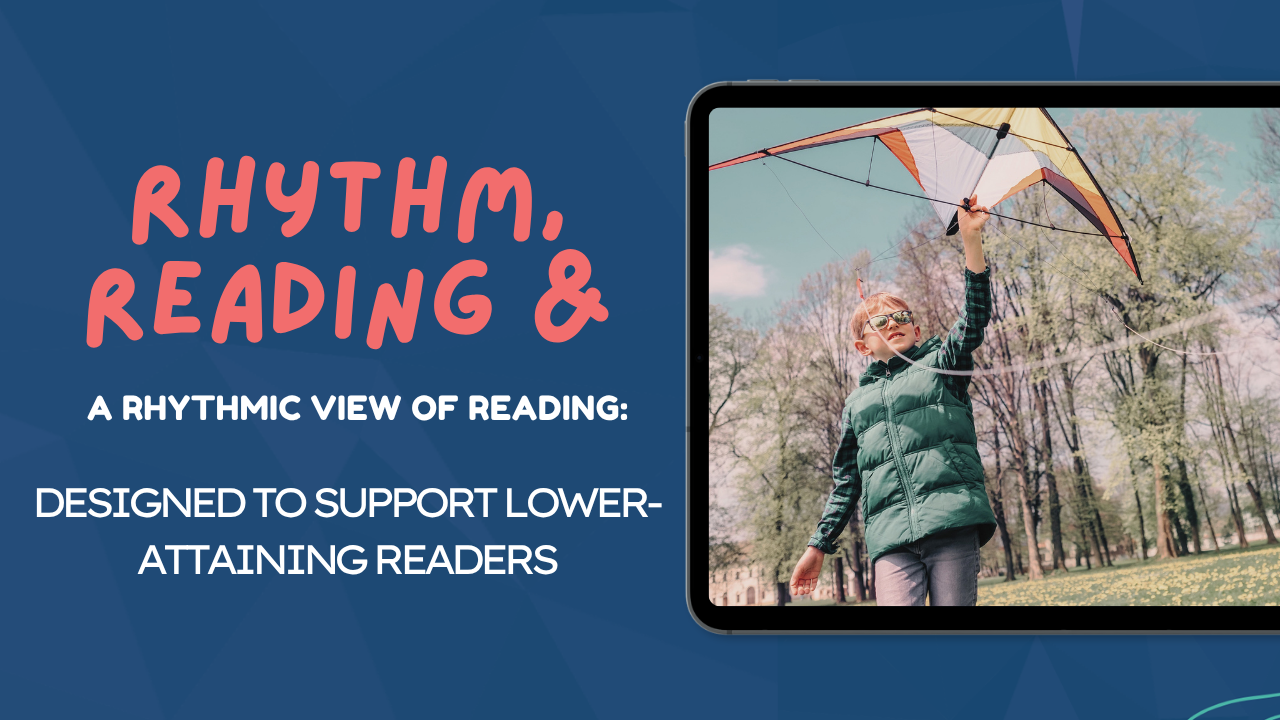
Music is like this too. We can stay on one note or we can enjoy the feeling of velocity that bends the music into beautiful shapes, a bit like flying a kite. In fact without the breeze, the kite would lose its ability to stay in the air and I think this is true of playing music and learning to read. The breeze of course is a metaphor for rhythm - the motion that arises in language to create utterances and phrases.
When reading is word by word, the kite is not yet flying in the breeze. The patterns that shape phrases into a grammatical structure lack that impetus and coherence that rhythm provides. It is natural to hope that familiarity with the words will provide the much needed momentum. But what if the child just needed to release their need to grip each phoneme and each word, and instead simply launched their reading rhythmically - like a kite into the breeze. In my experience, this becomes possible in a rhythm-based approach that uses simple musical notation instead of words.
The need to ‘launch’ is one reasonable explanation for the progress many children make across the ten weeks of Rhythm for Reading. A child who was stuck reading at the word-by-word level and says, “I don’t need so much help now,” has begun a new relationship with reading.
When a child reads accurately but doesn’t understand
Have you ever driven to work and arrived on time, but because the journey was familiar and unremarkable, your mind was free to wander, to ruminate and to daydream and you parked your car unable to recall anything specific of the journey at all. This ‘spacing out’ is similar to the experience of accurate readers who do not engage with the meaning of the text while they read.
Language is embodied as well as social. Language flows from us, between us and within us. Language can be typed, carved, spoken, sung, read or heard. This is why reading comprehension is not necessarily explained very well by an equation. This particular lack of contextual relatedness in the Simple View of Reading limits what it can tell us about reading in the real world. In my opinion, lower-attaining readers need to experience language in the context of relatedness enriched by rhythm.
Rhythm for Reading offers children an embodied cognitive scaffold. It gives lower-attaining readers an experience of reading in time with music, with their own rhythmic actions and in the context of a small group. Reading becomes a rich and consistent experience of belonging, of motion, of teamwork and of learning together in a joyful way. In my experience, ten weekly sessions are enough for lower-attaining readers to begin to discover that they can engage with text meaningfully.
How lower-attaining readers try to hide their difficulties in class
Lower-attaining readers may pretend that they are coping well. Many seem to learn that not knowing the answer risks shame, and so they prefer not to ask for help. They want to be seen as the same as everyone else. Concealing their struggles with reading is a bid for safety and may involve memorising a text and looking as if everything is just fine.
This is not a happy state of affairs for any child and a sensitive teacher able to earn a child’s trust may even persuade them to ask for help. Even then, the teacher may discover that both the child who braces when reading word by word, and the child who is not visibly struggling, but does not process the meaning of the passage need a similar kind of help.
A few minutes of listening can be enough to notice certain signs
A child reading an unseen passage accurately and at pace may look fine on paper, but if we listen closely, we hear that there’s little or no shape. They are reading the words but not the text and when we ask them to explain what happened in their own words, they may concoct an elaborate but irrelevant answer, or they may say nothing at all, or they may read back the sentence containing the ‘keyword’.
The child reading word-by word does not have a sense of connection between the words, so there’s little or no shape in their reading either. Understanding the passage happens after they have read it and requires a certain amount of guesswork, or long periods spent searching for answers.
Children can fixate on the individual words either very slowly (word by word) or at pace and these are two of the five signs that lower-attaining readers need a different kind of support. It’s understandable to assume that they are not exposed to a rich enough vocabulary, but if they have been attending school for a few years that is unlikely to account for the lack of shape in their reading. A rhythm-based approach however, is a different kind of support that can help lower-attaining readers to experience shape in their reading and a stronger connection with the text.
A rhythm-based approach alongside phonics
A rhythm-based approach extends, complements and supplements excellent phonics teaching. Rhythm for Reading sessions are short, energising and combine rhythm-based actions with reading and specially commissioned background music. The children enjoy learning to read simple musical notation, as this offers a ‘fresh start’ for many and means that their previous experiences with reading letters and words do not carry over into the sessions. Although the sessions are lively and brisk in pace, progress is calm, because of the structure of the programme as a whole. After only a few weeks, children start to report that their reading is getting better.
If you've enjoyed this post, download the free guide 👇
5 Signs Lower-Attaining Readers Need a Different Kind of Support.
FAQs
Why does my pupil read accurately but not understand?
Some children read the words but not the text. Like a driver who arrives at work with no memory of the journey, they reach the end of the passage without engaging with its meaning.
Why do some children read word by word?
In my experience, they hold onto each phoneme and then each word. A rhythm-based approach can help them launch their reading - a bit like launching a kite into the breeze.
Why do children pretend to read?
Pretending develops out of necessity. Not knowing the answer can feel risky, so some children memorise texts or want to look as if everything is fine.
How does Rhythm for Reading fit with phonics?
It extends, complements and supplements excellent phonics teaching, with short, energising sessions and calm, steady progress.
REFERENCES
Duke, N. K., & Cartwright, K. B. (2021). The science of reading progresses: Communicating advances beyond the Simple View of Reading. Reading Research Quarterly, 56(S1), S25–S44. https://doi.org/10.1002/rrq.411
Gough, P. B., & Tunmer, W. E. (1986). Decoding, reading, and reading disability. Remedial and Special Education, 7(1), 6–10. https://doi.org/10.1177/074193258600700104