The Smallest Step, The Liveliest Ten Minutes
What happens to struggling readers in the summer term?
There’s a stark contrast between the exuberance of June ‘in nature’ and the intensity of the final weeks of the school calendar. I don’t need to spell it out, because it’s obvious and if we’re honest, June can feel like a month of endurance. From marking to report writing, from data to Year 6 transfer days, the ‘to-do list’ is longer than usual. The warmth of the sunshine, the impassioned birdsong, the scent of the trees and the honeysuckle are enticing, but the relentless requirements of the end of term keep you at your desk. Perhaps the PE teachers are the only ones with a spring in their step, noisy banter in full swing as they visit the staffroom only to refill their water bottles.
For me, on top of the usual workload, June was always extra busy, with a flurry of new SENDCO referrals. Pupils who had not finished their exam papers were being flagged as potentially needing extra time. I’d speak with teachers, examine the scripts across a range of subjects, speak with the pupils, the parents, screen them and write up their reports and my recommendations for teachers, parents and pupils. The process was thorough and designed to ensure that the school would never overlook or neglect the specific needs of the pupils, but also comply with the JCQ regulations. It was a crazy way to end the school year, and as a part-time teacher I put in many extra hours at the beginning and end of every day to get it all done.
That was in the independent sector and I know, because I visit many different types of school, that in the maintained school, the process is different. There are waiting lists for referrals and the accountability is set up differently. The level of pressure is more intense and distributed across the whole school, because class teachers are left waiting for answers and still asking the question that everyone asks, which is about appropriate response, ‘Should I discipline them or support them?’
This is the right question to ask. Usually, a difference between a child’s ability and their attainment or processing speed goes some way to explaining why they display frustration, have meltdowns or withdraw or become spaced out. I used to find that helping a child to understand their own way of working and the barriers they experienced would help them to recognise why they felt upset or shut down. Once the child, parents and teachers were on the same page and had a ‘workaround’ for a specific learning barrier, the behaviour improved and confidence in learning began to grow. All of this was bespoke and specific, and worked well in an independent school. I loved the work, but I resigned when my application for funding from the EEF was successful. This project required full-time input from me and I saw this as an exceptional opportunity to build on my doctoral research on the effect of a rhythm-based intervention on reading development. It focused on children who were not necessarily on the SEN radar, but were not meeting expectation. [Read more about that project here.]
When phonics isn't enough: The child locked in vigilant attention
When schools invite me to work with them, I am so moved by the teaching that I see. In fact, I begin my introduction to Rhythm for Reading, by telling the students how fortunate they are to have such dedicated superb teachers in their lives. These are the people who sit up all night marking, and spend all day pouring themselves into their pupils until they see their faces light up. The remarkable effect of great teaching is magical to see, energising and rewarding, for the teacher and students alike. This people-centred work is highly skilled, accomplished and life-changing.
This willingness to teach is the main resource that a school has. If the lesson does not spark engagement and if the teaching does not feel rewarding and energising, because the receptivity on the part of the students is not there, it acts as a drain on the teacher. For example, if there are children with additional needs in the classroom, who require additional support and are not able to access the curriculum, the lack of support feeds the frustration of the child, denies the other children the energising effect of learning together as a group and depletes the energy of the teacher. The energy of the teacher is the most precious resource that the school has. With schools set to become more inclusive, the resourcing of the schools has to meet the needs of the SEND children, and protect the rewarding and energising dynamics of teaching and learning for every child, every day.
Some children are dealing with barriers to learning that are too painful to name. These children are living with emotional turbulence that affects their social behaviour and their learning. Encouraging them to ‘try harder’ doesn’t work. These children are waiting for someone to show them that they matter and belong at a visceral level - these are basic needs that everyone else takes for granted.
Teachers are well-placed to do this sensitive work and transform children’s lives, day after day, year after year. However, some children who are shut-down or impulsive or unpredictable, too vigilant to learn, too defensive to trust can deplete even the most heart-centred, experienced teachers quickly. Even though the teacher is equipped with everything the child needs, that child may not be able, ready, or willing to open-up and engage. Until this happens their attention is locked in vigilant mode [click here to read more about this].
What rhythm does for attention, executive function and reading fluency
Rhythm is all around us and within us. Heart-rate, breathing rate, walking rate, chewing rate: we are always in a rhythmic state of some kind physiologically. But when children have been frightened, they are often locked in vigilant mode. This means they remain in a state of high alertness, focused on their surroundings, scanning for threat. Their subconscious is ready to react as needed, and this is why they are not able to access their full range in terms of learning and social interactions.
By contrast, a child in a rhythmic state is socially relaxed and able to lose all awareness of their surroundings as they read a book, or play with their friends. They are locked into what might happen next. This is future-oriented attention. The child’s conscious mind is absorbed by social interaction, including learning, anticipating and adapting in the moment.
Teachers can feel future-oriented attention building in a classroom when the children are hanging on their every word, eager to learn, their curiosity building with every second that passes. Their anticipation is key to engagement. The teacher can see and feel which children are intrinsically motivated and poised to absorb the information, the questions, the task, set in the lesson.
Moving children from a vigilant state into a rhythmic state involves building trust over a long period of time. Sometimes intergenerational distrust of school has been passed from parent to child. I have seen School-Home Support practitioners working very hard to work with parents and children to break entrenched cycles of behaviour. The results have been beautiful and the parents have been willing to see school in a new light.
Rhythm-based intervention offers a different route. When rhythm and music are in the environment, they can capture, hold and mould the attention of the vigilant child in an instant. The humour, colour, imaginative patterns and deep structures written into the resources I've created with Eric Crees are sufficient to move the attention into a future-oriented state, [Read more here].
The response of the child is delight because their environment, the same environment that they are constantly scanning for threat, has delivered a surprise, a gift, a sense of playfulness that they could feel. This is when the light floods their face. Is it relief? Is it a sudden integration of all the energy that had been held in reserve for an emergency? Perhaps it is both. The child has not been coaxed into learning, like a tortoise persuaded to emerge from its shell at the scent of a lettuce leaf. The movement, the sound, the sense of belonging that rhythm provides are fully embodied by the child. They accept rhythm’s invitation to meet the others in the room with the same playfulness, exuberance and joy. This is what releases the 'headlock' of vigilant attention.
Every teacher knows that a child cannot be both delighted and vigilant at the same time. Joy is inherent within the rhythm. Joy is the mechanism. The child chooses joy and experiences future-oriented attention and inhibitory control, all the while surrounded by other children. There are endorphins, oxytocin, dopamine, serotonin and perhaps with the help of these reinforcing 'feel good chemicals' the child recognises the value that joining in with others brings.
Imagine the even greater gift that the child experiences when they realise that they can follow what the teacher is saying for the first time. The most rewarding moment is when the child realises they are ready to learn and to make progress because at last they can absorb the wonderful teaching that was always there for them.
Trialling a rhythm-based reading intervention in ten minutes a week
As a researcher, I was once asked to supervise a ‘pre-pilot pilot’. This is the most tentative form of pilot. This is the lowest of low-stakes trials. It is one hundred per cent exploratory and entirely risk free. No one is asking for a career-changing commitment. There is simply an understanding that there may be a basis for a modest investment in an idea.
I was too busy, but I appreciated being asked. I found the concept intriguing because it seemed so cautious, and so unlike my own approach which I have built on decades of intensive reading, observation and iteration.
If a handful of children spent ten minutes in a room with one open-minded teacher, who was willing to explore a rhythm-based intervention in a low-risk, contained and short-term commitment, what might happen?
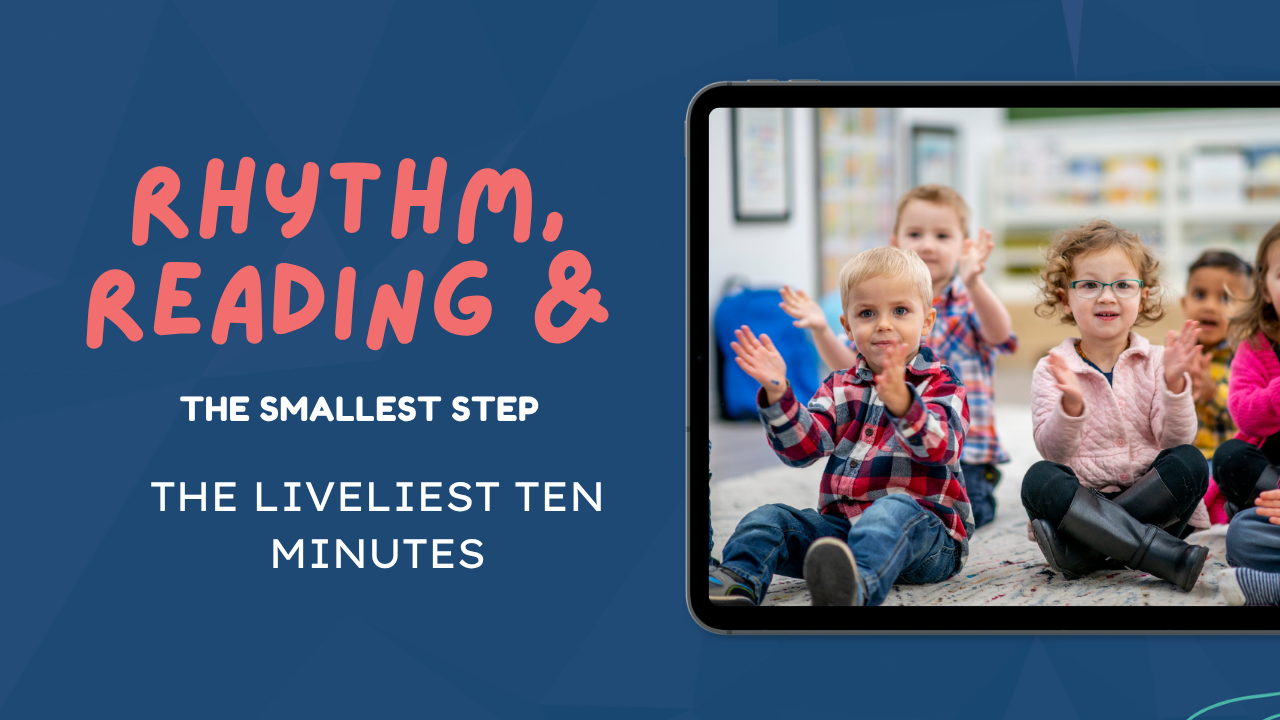
They would hear magnetic melodies, see smiles, feel the children move to an easy beat, witness focused concentration and see them learn to read music in five minutes. The teacher and children would shout ‘splash!’ as a team, laughing and become mesmerised by the dinosaur story. They would leave the room wanting more, but then return to class feeling joyful, only to discover that everything had become clearer.
The experience is exuberant but that first step to make this opportunity available is so small. It’s not a massive whole-school initiative. It’s a commitment to model curiosity, to ‘give something a go’ in a small room, for just ten minutes a week.
It starts with one curious teacher and the cost of one CPD day
One curious teacher, with an open mind is all that is required to get started.
If there is one member of your team, who is comfortable working with music and willing to try something new, then they will introduce the delight that rhythm-based intervention brings into the school community.
If there is room in your budget for one teacher to have one CPD day, the complete training on the Rhythm for Reading programme is available to you for an entire academic year.
The children who respond most and a free set of rhythm games
The children who are depleting teachers fastest are often those who respond best to rhythm-based intervention. In Special Schools for children with attention and behavioural needs, teachers have told me that they have never seen these children engage so intently. Usually, these students’ attention is scanning the room. They are on edge and ready to react. And yet, the teachers can see their attention is absorbed, held and moulded by the music and they become part of it, anticipating what is coming up next, because the resources are designed to enable this [read more here].
If you’re a school leader who wants to re-energise your classrooms and support your teachers in reaching every child, Rhythm for Reading offers a simple and joyful way to begin. It starts with one curious teacher, one small room and ten minutes a week.
And if you’re a teacher who feels that spark of curiosity, who wants to see your pupils’ faces light up, I’d love to invite you to train with me. You’ll discover how rhythm can unlock attention, trust and joy in learning.
You can join me at my next webinar to explore how it works in practice, or if you’re ready to begin, get your free set of ten joyful games to try right away.