When some children lose focus on reading (and what helps)
“I can only hear myself read.” (Year 3 child after 10 weeks of Rhythm for Reading)
This was said in the context of not chatting to other children. I wondered whether they meant they were able to focus better on their reading, because when people describe entering a flow state they tend to refer to an expanded sense of time and ‘losing themselves’ in the task at hand. So this sense of deeper focus on reading was one possible interpretation. The alternative view, based on what many children say, is that their reading has become clearer, perhaps because the sounds of language are easier to perceive. I tend not to jump to conclusions, but I do find that the reflective process helps me to maintain an open mind when I listen to lower-attaining children, as they read aloud.
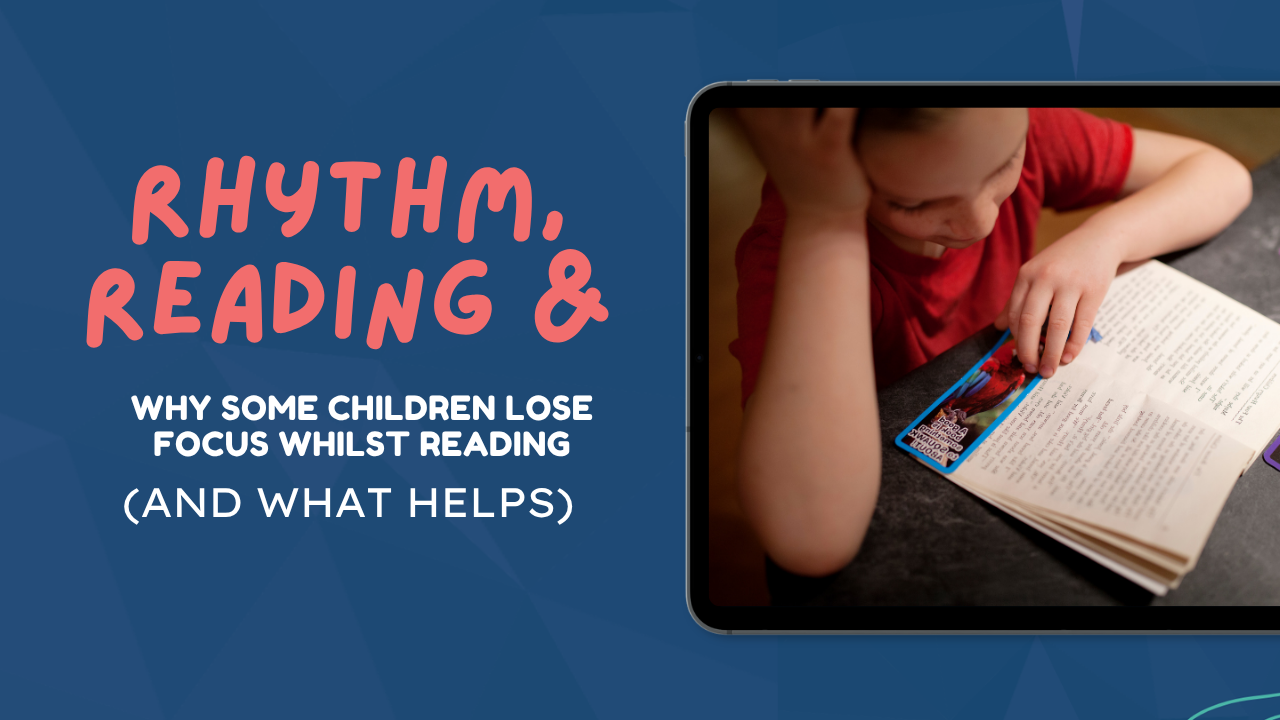
Losing their place, skipping words: what fading attention looks like
Some people might assume that if a child loses their place on the page that they do not care enough about their reading or that they are bored by the text. Sometimes, the problem has been there for so long that the child no longer cares and has become bored by what they perceive as the pointlessness of reading, not just this text but any text. But with a little curiosity, we might ask whether there’s a pattern in the errors. We might then ask whether they happen anywhere in particular on the line or on the page.
Sometimes the errors cluster at the start, the middle or the end of a line. Often, though, the flow of reading is disrupted by the quality of attention itself, which to my ears fades, fragments or scatters. When attention is not sustained sufficiently to support the decoding of a word or the shape of a phrase, reading can become static and fluency is compromised.
Children with attention that fades, fragments or scatters can write themselves off as readers and learners, especially if no one identifies this and helps them to focus their attention. They may appear hyper alert or somewhat lethargic and spacey. However they present, they find it hard to sustain attention well enough to engage with reading or learning. They may not need a formal identification or a label, but they do need a supportive social environment that will nurture their attention and support their reading.
Why writing shows fading attention most clearly
I’ve noticed that at the end of the Rhythm for Reading programme, many children are keen to tell me about the writing they are doing in class and that this means a lot to them. I have accumulated so many comments about writing and wondered whether this was something that I would write about one day. In the context of attention that no longer fades, fragments or scatters, it makes sense that children would be able to hold their words in mind until they'd transferred their phrases and sentences to the page.
Children have also told me that they no longer chat to their neighbour. Once again, I was not sure how this would sit in relation to an improvement in reading comprehension, but of course, it can feel easier to say the page is blank because you were talking, than to admit the words faded before you could write them down.
The Simple View of Reading: An elegant aerial view
An aerial view, whether of a landscape or an urban area can make no sense at all, until the moment when you know this is the view from above. The view from above is simplified and offers the ‘big picture’, with the most salient features taking prominence. Gough and Tunmer’s Simple View of Reading (SVR), in my opinion offers an elegant aerial model of reading, with the most salient features of reading comprehension (decoding and language comprehension) foregrounded in what Hoover and Tunmer (2022) described as a ‘static model’. The SVR gains even more credibility by presenting the model in the format of an equation.
Although Hoover and Tunmer (2022) asserted that the SVR is not a ‘developmental model’ of reading, I would add that it is a model that categorises three types of reading difficulty: poor decoding, poor comprehension, or both (Gough and Tunmer, 1986) and in terms of parsimony, this model works well.
The advantage of maintaining a ‘large grain-size perspective’ (a phrase used by Hoover and Tunmer, 2022) is that the principles of the model endure and assure a particular level of standardisation and equality in delivery of the teaching of early reading.
Indeed, according to Duke and Cartwright (2021) the Simple View of Reading is the model most often presented to teachers, and in England, it is prominent in the DfE’s Reading Framework.
But what happens when we toggle from aerial to 'street view'?
The 'street view': where attention fades and scatters in real classrooms
At ground level, in classrooms, in amongst the to and fro of teaching and learning, there’s a more complex view of reading that involves attitudes, motivation, social and economic factors, languages spoken at home, social interaction, neurodiversity, SEND and internal and external pull and push factors that impact school life from day to day.
Rather than three types of reading difficulty there’s a very broad range of learning differences. Most children are doing their best (even if they appear not to) and each responds in their own way to the page in front of them. The sheer complexity of classroom learning cannot be perceived from an aerial view.
The 'street view' allows us to see that people and ideas can intersect, bringing their prior experiences with them. The SVR does not describe the more granular detail of social interactions or the affective influence of attitudes towards reading, nor does it allow for the influence of personality or identity on alertness and readiness to read and to learn.
Indeed, Duke and Cartwright (2021) argue for the addition of active self-regulation and executive functions when expanding the SVR model. I would argue that children have the potential to read well and can enjoy reading if they are supported by their environment. Adults in this context are the environment and as such support children in the development of their self-regulation and executive function.
The 'street view' allows us to see real classrooms in which attention fades and scatters, perhaps because active self-regulation is still developing and needs more support. In this sense, we can agree with Hoover and Tunmer’s (2022) assertion that the SVR is not a developmental model of reading. All things considered, it seems sensible to acknowledge that both an aerial and a 'street view' can offer very different perspectives and that both can be ‘true’ representations at the same time. Educators who can toggle between the two views are better placed to interpret the Simple View of Reading model well.
Attention is shared before it is individual: why small groups help
A child’s environment consisting of caregivers and siblings provides the context for attention, focus, communication and regulation. These foundations are social and described as enculturation. They are built in the first year of life and shape the way an infant interacts with their home environment, including participating in the language, the values and customs. The importance of learning in a small group setting emerges from this principle. Kirschner and Tomasello (2009) demonstrated the importance of a social context for young children. Children aged from two and a half to four and a half years of age synchronised their drumming with higher accuracy when drumming with a human partner than when drumming with a machine or a recorded drum sound. In a different study, the ability to synchronise with other children in group music making predicted attentional behaviour (Khalil et al., 2013).
With effective training, non-specialist music teachers can apply group synchrony in short, weekly sessions of ten minutes to support attention of small groups of lower-attaining readers, with gains in reading accuracy, rate and comprehension (Long, 2014).
Moving the science of reading forward
Despite the advances in educational research, including the ‘science of reading’, the most important model presented to teachers appears to have retained its position for four decades. Duke and Cartwright called for teachers to be made aware of progress in educational research, particularly the ‘science of reading’, and sign off with,
‘[Similarly,] research related to reading education (and other educational domains) continually offers new insights that should be known to teachers and others involved in education.’ (2021, p. 539).
In a compelling defense of the SVR, Hoover and Tunmer (2022) pointed to the clarity of the model and asserted that its usefulness to educators was backed by decades of research.
My perspective is that the ‘big picture’ offered by SVR and the practitioner’s experience of everyday teaching and learning are very different. The lens matters. In terms of scale, a microscope offers a different view to the camera in the sky. And in terms of epistemological approach, both a randomised controlled trial and first-person ethnography can offer valid and credible data, albeit through a different world view.
A willingness to challenge ‘certainty’ is an important aspect of scientific reasoning. Each advance in terms of science is dependent on great minds capable of questioning assumptions and established ‘knowledge’. As we move forwards, challenging our own thinking, building greater precision into our frames of reference, scientists will in the future form a new world view, one which explains inconvenient data - the outliers, one that enriches the frameworks that are already so promising.
‘Science is not nourished by certainty. It is nourished by radical uncertainty. It is built upon the possibility of calling certainties into question’ (Rovelli, 2026, p.34).
It may feel easier to allocate resources to the more familiar, the more certain ways of doing education and educational research, but given that, in my experience, many lower-attaining readers respond well to a rhythm-based, small group intervention there is potential to widen the aperture and consider different kinds of support.
How rhythm can strengthen attention in lower-attaining readers
They anticipate what is coming up next.
“The children become better at being able to anticipate what is coming up next in their reading. They do not feel targeted because they are taking part as a group.” Deputy Head Teacher, Wales
The sessions are energising.
“The children don’t realise how hard they are working because they are having so much fun.” Lower KS2 Phase Leader, London
In research on rhythm and reading, two questions matter as much as the result: who the approach is for, and how the rhythmic tasks are structured. In my research (Long, 2014) and in fourteen years of delivery, the children who respond most clearly have been lower-attaining readers. Lower-attaining readers perform differently on tests, learn differently in the classroom and I argue that they need a different kind of support.
If you are noticing this in your school, download the free guide: 5 Signs That Lower-Attaining Readers Need a Different Kind of Support.
FAQs
Is fading attention a sign of ADHD?
Fading attention has many possible causes, and the guide does not diagnose any of them. Rather, it describes what you can observe in a child’s reading before seeking an assessment.
Isn’t this a behaviour issue?
Reading is a behaviour. Learning is a behaviour. Sustained and focused attention is required for reading and learning. Children want to join in and to learn alongside everyone else in their class. I have not yet met a child who said they felt disappointed when they became able to follow the lesson and join in with the class. Many of the most reluctant readers express relief and joy when they discover that they can read further and understand what they are reading.
Can a child decode well and still lose focus?
Yes. Imagine reading a string of numbers that take up an entire page. If a narrative exists, this is not something you are able to access. You may try to keep your place, try to read the numbers fluently and without making a mistake, but the control required to read each separate integer soon depletes your attention. Maintaining focus takes disciplined effort and soon, this feels pointless. You feel yourself losing motivation, especially as the print becomes smaller and the paragraphs become longer.
Why does working in a group help attention?
Learning is social and attention sustains learning. Attention is cultivated between infant and caregivers through singing, bouncing games, rhymes and rituals such as ‘peek-a-boo’. The exchange of smiles, chortles and laughter in these early months is the foundation for an attention span, the acquisition of language and other learning and takes place through all the senses. The opportunity to rehearse all of these games again through playful encounters in early childhood reinforces the social context for attention and learning. Working with rhythm in a small group setting creates another opportunity to strengthen or stabilise the foundations for language and attention.
REFERENCES
Duke, N. K., & Cartwright, K. B. (2021). The science of reading progresses: Communicating advances beyond the Simple View of Reading. Reading Research Quarterly, 56(S1), S25–S44. https://doi.org/10.1002/rrq.411
Gough, P. B., & Tunmer, W. E. (1986). Decoding, reading, and reading disability. Remedial and Special Education, 7(1), 6–10. https://doi.org/10.1177/074193258600700104
Hoover, W. A., & Tunmer, W. E. (2022). The primacy of science in communicating advances in the science of reading. Reading Research Quarterly, 57(2), 399–408. https://doi.org/10.1002/rrq.446
Khalil, A.K., Minces, V., McLoughlin, G. & Chiba, A. (2013). Group rhythmic synchrony and attention in children. Frontiers in Psychology, 4. https://doi.org/10.3389/fpsyg.2013.00564
Kirschner, S. and Tomasello, M. (2009). Joint drumming: Social context facilitates synchronization in preschool children. Journal of Experimental Child Psychology, 102 (3), 299-314. https://doi.org/10.1016/j.jecp.2008.07.005
Long, M. (2014). ‘I can read further and there’s more meaning while I read’: An exploratory study investigating the impact of a rhythm-based music intervention on children’s reading. Research Studies in Music Education, 36 (1), 107-124, https://doi.org/10.1177.1321103x14528453
Rovelli, C. (2026). On the Equality of All Things: Lessons on Physics and Philosophy (S. Carnell, Trans.), Penguin Random House, UK