How rhythm reached the children that conventional teaching could not.
Every teacher knows that look on a child’s face. It’s the one that says, “I’ve already failed.”
When good teaching is not enough: The day I met the ‘football children’
There’s sometimes a huge contrast between the beginning of a lesson, the middle and the end. Let me explain. I was once introduced to a group of nine-year-old children by their class teacher. They were ‘challenging’ having been excluded temporarily and according to their class teacher had ‘complex’ home backgrounds with involvement from ‘agencies’. I was young, a keen cello teacher, confident in my work teaching children one-at-a-time, but I had never taught the cello to a group of children before. What could possibly go wrong?
Their class teacher had warned me ‘Not to worry’ if I couldn’t teach them because she ‘could do nothing with them’. I smiled, wondering what the problem could be. She was the most experienced teacher in the school and close to retirement. The primary school was one of the best in the area, having sailed through the first round of inspections with ‘Outstanding’. The Head loved music and there was even a school orchestra. I wanted to teach there very much and was keen to make this important opportunity work.
My own situation was somewhat precarious. My mortgage payments had doubled following a hike in interest rates thanks to ‘Black Wednesday’ and I was struggling with bills. I needed this work to keep a roof over my tiny children’s heads. On the other hand, I’d had consistent success teaching in a range of local schools. I was growing my teaching practice and wondered whether I’d regret ‘branching out’ into unknown territory.
The class teacher waved as she left me in the music room, surrounded by cellos, violins and a trolley full of tambourines, jingle bells and triangles. As I set six chairs in a circle there was a scream as the children tumbled into the room. One had fallen forwards. One had his arms in the air, his head thrown back, triumphant as if he’d won a race. Another was trailing behind, dark circles under his eyes, pale and lacking energy.The others clambered up onto their feet, giggling, exuberant.
The look that changed everything: why struggling children expect to be blamed
I set to work. They were delighted to hold the cellos but their high spirits meant the cellos were about to be broken. I whisked the instruments out of the way and tried a handful of other approaches - clapping, singing, mnemonics and chanting games. I kept the lesson light and easy-breezy, but after twenty minutes the energy in the room drooped. On the bright side, the lesson had been fast paced and nothing had been broken. On the other hand, I knew that the teaching and learning had not worked. I could not justify taking them out of the classroom for thirty minutes every week unless I could engage them.
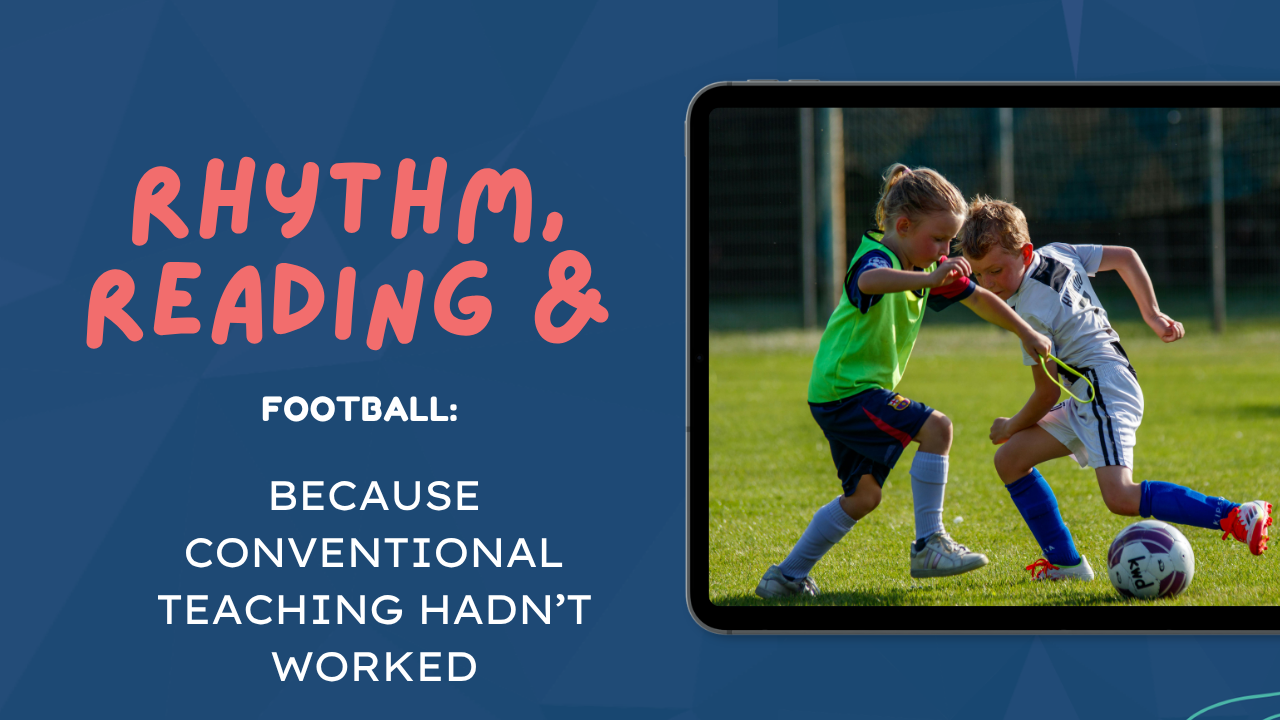
Ten minutes remained. Their eyes were scanning mine. Their faces were tense, bracing for bad news. I understood why their class teacher had tried to manage my expectations. She’d been realistic. Perhaps I’d been naive to even try to make this work. I knew that I could send them back to class and admit defeat. Looking at the dread in their eyes, I knew they expected me to blame them for what felt like failure. The playing field glistened under the May sunshine. I imagined them running free out there and asked what they loved to do after school. Football.
We know that practice makes progress and that repetition leads to muscle memory, so the final part of the lesson did work. The children were in their relative zone of genius and could adjust the way they marched in time and responded well to the music I played on the keyboard. Chaos turned into concentration. They’d stopped clowning and were calm as they followed my instructions. Much to my surprise, I realised I’d found the way in.
Why children who are falling behind cannot focus and what is actually happening
The contrast between the three parts of the lesson is striking. The beginning of the lesson involved gauging their unpredictable ways of speaking, moving and laughing. Their energy would flood the room in sudden contagious gusts. They seemed happy, but they were actually trapped in an emotional pendulum that delivered wave after wave of coping and performing Between the waves there was restlessness.
Beneath the surface of all this agitated exuberance, there were complicated feelings of dread, tension and fear of exclusion. I saw this when I paused the lesson, twenty minutes in. Looking back, at this moment with the benefit of many years of work with children who are not yet reading well, it’s easier to interpret the contrast in their behaviour: the excessive waves of energy and the stillness that framed fear and dread.
When children feel they belong and matter, these contrasts may be present but because the children do not feel they are trapped in a classroom that does not meet their needs and that they probably are unlikely to face exclusion, the big disruptive energy may not arise.
Children do worry about not reading well. They want their reading to open doors for them, as it does for the others in their class. When children do not read well, despite excellent teaching they blame themselves. They feel they have let down their parents, their teachers and themselves. They know their future looks rather dark, shadowy and scary, when they’d assumed it would continue to offer brightness and hope.
These feelings of apprehension and dread can develop into barriers to learning, with behaviors that range along a spectrum from disruption to withdrawal, locking the nervous system in a state of vigilance (which sends attention outwards to scan the perimeter of the classroom) in constant threat detection.
When children are in a state of vigilance they may display rapid reactions or they may shut down, space out or dissociate. They prioritise threat detection above learning. This is not by choice, but the consequence of perceiving that they are not meeting expectation. This is an abrasive process of educational alienation and social ostracisation, felt all day, every day.
First, children realise that they are not meeting expectation, because they decipher the ability grouping system in the classroom. Next, they compensate for the emotional shock by clowning, disrupting or withdrawing. Lastly, they know that fighting the sense of ‘injustice’ every day is unsustainable and they accept that they must learn to perceive themselves as ‘different’. The suppression of self-determination and agency leads to diminished self-esteem, and learned helplessness takes hold.
Rhythm is impacted by these changes. In my experience, when children are in ‘threat detection’ mode, they seem to experience time in short brittle bursts that are discrete, rather than perceiving the connected flow that learning requires. They have no access to their working memory, where information is held and manipulated in real time as we think and respond.
In a threatening situation, working memory is unhelpful. There’s no time for thinking. Taking the right action without thinking is more likely to save lives, thanks to the brain’s threat-response systems, which evolved to prioritize survival. This is why children in vigilant mode are unable to focus, even when reminded. The question is whether rhythm can move children out of a vigilant state?
How rhythm moves children from vigilance to readiness, and why it works when teaching alone cannot.
Yes rhythm is highly effective for activating and calming the nervous system. There are many examples in everyday life. Newborn infants are calmed by rhythmic movements such as swaying, rocking, bouncing. Changing the rhythm of the breath, such as practicing a ‘long exhale’ or a yawn settles the nervous system. Marching together in time builds close bonds of trust, as seen in military units. Each of these practices involve releasing feelings of isolation and gaining an awareness of belonging, to a caregiver, to a sense of the ‘bigger picture’ and to one’s peers.
When I asked my group of nine year olds to use their feet, they were no longer trapped within the invisible learning barriers that they’d constructed around themselves. Rather they started to connect with each other and with me through the rhythm, using their feet. This was so simple and worked because they had built up strong awareness of their feet through playing football.
Using rhythm, I devised the process that moved them out of their vigilant state at the start of each lesson. The greatest reward was the children’s delight as they accomplished new skills week by week. They would watch me intently as I showed them what to do and they were always focused and attentive, and were even happy to be corrected and helped.
“I Can Do It!” What happened when the children read music for the first time
I lost their trust as soon as I announced that they were going to learn to read music. They reverted to a vigilant state in a flash. Their faces were strained and pale and one child shouted, “No!” And ran over to the door.
The dramatic reversal of all our great work was astonishing.
With reassurance, they agreed to try. They were reluctant and fearful, but they agreed to try to read music.
Five minutes later, they read a simple line of music fluently. I will never ever forget the way their faces lit up and the triumphant sound of relief in their voices as they shrieked,
“I can do it!”
“So can I”
“So can I”
They left the lesson having moved from a state of vigilance and learned helplessness, into agency and self-determination. This is where they started to see themselves as learners, as children with a brighter future.
Rhythm for Reading supports children who are not yet reading well
Rhythm for Reading is designed to support children who are not yet reading well, who have an incomplete perception of the sounds of language, who cannot focus because their concentration scatters or fades before they can control it, who can read the words but find reading is meaningless. These children are also experiencing the emotional cost of not meeting expectation and as time passes, the gap between them and their peers grows wider.
The children who are falling behind need rhythm to bridge that gap. We would not think twice about soothing an infant through rocking, swaying or bouncing. And yet, if children are unable to focus in class, they are expected to figure out how to manage the problem by themselves.
The conventions of the education system
The conventions of school involve sitting at desks, reading in silence or listening to one person read aloud. I understand how powerful this framing is. I was terrified that I would lose my job if someone saw me teaching the children while they were standing up and moving their feet. In fact when the Headteacher dropped by one week, I assumed that someone had made a complaint, but in fact he wanted to invite this group of children to perform in full school assembly in the presence of the Ofsted inspection team. I was so relieved!
The school retained its ‘Outstanding’ status and the children excelled. They loved every second of their 'rise to fame' (as they saw it). I was thrilled that they were invited to join the school orchestra and were then sitting alongside the ‘high flyers’ of the school.
Their teacher said they had completely caught up and that she never heard a murmur from them and added,
“I don’t want you to think it was anything to do with you. It’s just maturation, that’s all it is.”
This was her extraordinary gift to the ‘future me’ who became a research student. But in that moment, I accepted her point of view as she was their class teacher. Over time, as I repeated the same process and other children and their parents remarked on the sudden change in their reading, I began to wonder more and more about the effect of rhythm on reading.
What thirty years of working with struggling readers has taught me about learning, rhythm and the ‘deficit model’
Here’s what I have learned as I’ve reflected on this 30 year journey. From the start it was clear that even the most experienced teachers in the most highly rated schools are unable to teach children who are in a vigilant state. This is because conventional teaching and learning is not possible until children have shifted out of the vigilant state, and only then, are they able to engage.
Throughout human history, across every culture we know of, people have used music, dance, chanting and breathing for the health and well-being of their community. A rhythm-based intervention offers the most effective and low cost way to support the nervous system. In an educational setting, rhythm can move children out of a vigilant state and into a receptive state that makes learning possible in a matter of minutes
If this has made you curious about the children in your school, I’d love to continue the conversation. Join me at my next webinar, where I explore how the programme works in practice and how it can support your school community.