Singing in time: What the end-of-term performance reveals about reading
We are in the season of Remembrance and this solemn time is poignant for us all. It’s a time for reflection and profound appreciation. We must never forget that our freedom to write, to speak, to sing, to dance, to share our opinions, to love and to live in a free society was fought and won on battlefields, in the sky and at sea. Brave servicemen and women fought for us, for our children and our grandchildren every day, every night, every week for months that turned into years, and many gave their lives. The privilege of living our peacetime lives is something we cannot take for granted as our lives are their legacy.
So, as we begin the process of rehearsing for the end-of-term performance, let’s remember how incredible this opportunity is and let’s make it count - not just because of the joyful energy it brings, but also because we are so fortunate to sing together, to tell a story together and to have the necessary safety for our self-expression to shine.
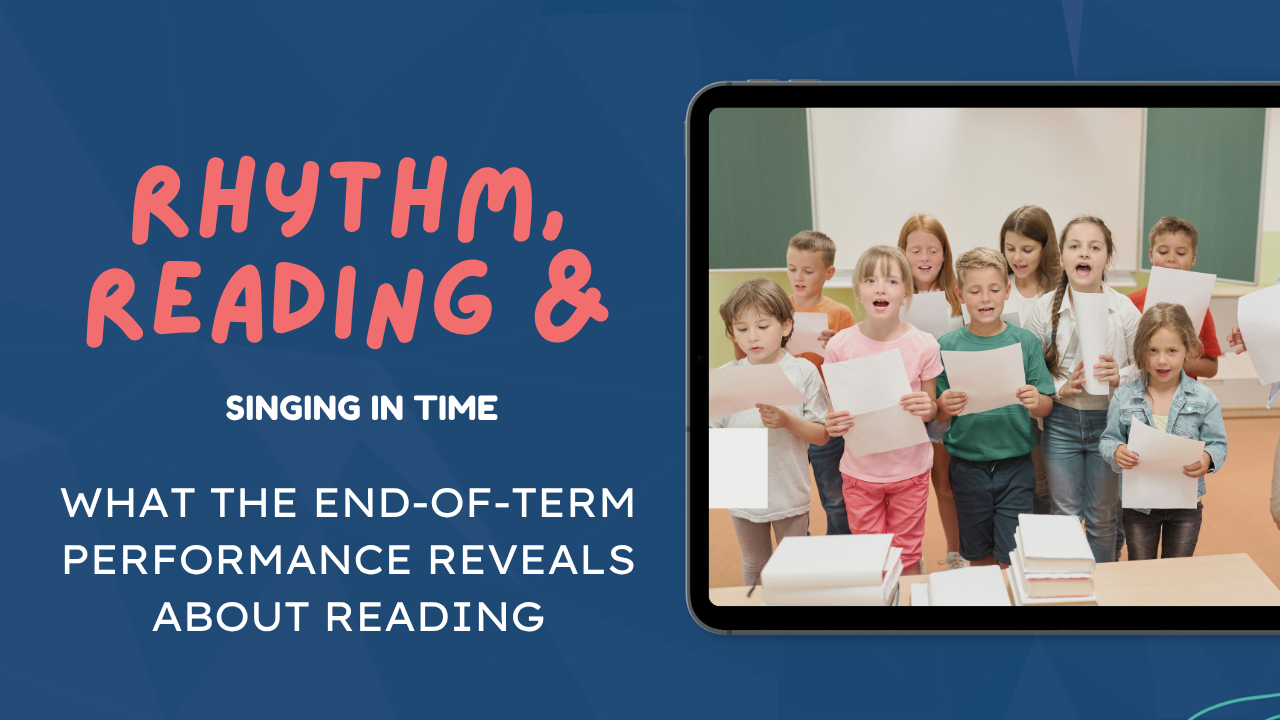
What can a rehearsal tell you about reading?
Safety, peace, love and joy are the precious keys to unlocking a truly inspiring end-of-term performance. And yet, it’s a little more complicated, isn't it? Each child brings their own unique blend of expectations and attitudes to the first rehearsal. Some will growl, mumble, mutter the words and others will enunciate with bell-like clarity.
What does this have to do with reading? More than it might seem. The willingness to participate and engage can tell us something subtle about reading well. The path of least resistance - in other words their willingness to engage wholeheartedly opens wide when children feel safe. This is why navigating the initial rehearsal with plenty of safety built in really matters. In my experience, challenges that are easy to manage mean that the children can experience fluency in the first five minutes and again at the end of the rehearsal. An emphasis on fluency first and last is the most effective way to help the children approach rehearsal two with enthusiasm.
Why does singing in time matter for fluency?
The schools I visit prepare for their end-of-term performances by practising the songs for ten minutes at the end of nearly every school day. There’s a backing track. The words come up on the screen and the children start singing. By the end of term, they’ve developed plenty of confidence and the result is strong and joyful. The majority of the children feel excited for the audience to come into the school and to share in their delight. The entire project brings the community together and becomes something of a litmus test - a way of testing the health and happiness of the teachers, the children and the families.
It’s not only a matter of effort. Beneath the surface, there are inequalities and these are more obvious when we ask children to sing in time. Keeping a beat, reading words in time with everyone else and sustaining focus come with ease and just enough effort for the majority of children. For others, there’s a dilemma. They know they can only read a few of the words before their focus collapses. They can only keep time by focusing on keeping up with everyone else and pretending to sing. They are not sure how to enunciate the faster-paced syllables and these in particular make them feel like zoning out. It’s also very loud and they wish they could leave the room.
Schools committed to building inclusive approaches care about the safety and belonging that each child experiences. Singing in time can bring everyone together in a very profound way, when done well. It can seem logical to give more time to the more complex songs with the more complex lyrics. In my experience, this weakens enthusiasm for whole-class singing and sends the signal that this is not for everyone - just for those who can already grasp complexity. We must slow down and trust that our children are willing to sing together in time with a supportive approach.
If we begin with the end in mind (thank you, Stephen Covey), which is inclusive, joyful, enthusiastic and inspiring singing, we start with simple lyrics and the most accessible rhythms and melodies. Building teamwork and connection through singing is free in the sense that we do not need to rush out and buy musical instruments, but earning engagement and enthusiasm from the whole class requires patience and trust. We must trust that they are going to build confidence in small incremental steps by clearing a path of least resistance. After establishing that they ‘can do it’, their joyful enthusiasm and fluency remain in place further along the rehearsal process, even when learning the more complex words and rhythms. In my experience, this learning process can be rapid, but must not feel rushed or pressured in any way - just fun.
What do you see when a child is out of time?
The rehearsals for the end-of-term performance are opportunities for nuanced teaching, but it’s understandable that the teachers directing the show are thinking about the big picture and how they will realise their vision. However, in each class some children will be feeling conspicuous and anxious because they are out of time, and experiencing the double discomfort of isolation in the task and exposure in the room.
In my opinion, inclusive approaches are the answer. An experienced teacher can see when a child is not breathing with the others, and when their face is not moving in time with the others or when their lips are moving but not in time with the singing. It’s not necessarily about what we can or cannot hear, but what is obvious and easy to see.
The real test of a good rehearsal is visible in the children’s behaviour just before and just afterwards. Are the children jumping out of their chair because it’s time to go into the hall or are they moving more slowly than usual? Are the children asking for more rehearsal time? Done right, singing together, moving together and narrating the storyline together are joyful, energising experiences that the children bring back into the classroom as enriched learning behaviours.
Which children might benefit from a closer look?
Having observed children who are not able to sing in time, perform actions in sync, or cover up for these learning differences by being a bit silly, what are the next steps to take? One approach would be to take each child aside and ask them what they find most tricky. Most likely they will not know how to answer, because it is difficult to express in words how being ‘locked out’ of the whole-class experience makes them feel, or because it is so uncomfortable, that they’d rather push the feelings down and out of mind. After all, they ‘get by’ in class most of the time.
In my experience, when we see that a child's rhythm is ‘off’ there’s an opportunity to identify how this shows up in their reading, their focus when following the lesson and their ability to transfer their thoughts into writing on the page. If a child is visibly zoning out and their attention seems to fade, scatter or dissolve too quickly, I might say something like this:
“I can see that you are trying your best. Do you sometimes feel that your concentration runs out before you have time to answer the question?”
If they say yes, I follow up with,
“Does it happen suddenly or gradually or both?”
Even asking these questions can be helpful because the child knows that their teacher understands the barrier to their learning. In my sessions, I can reassure the child by saying,
“I know how to help you.”
In this way, the end-of-term performance can become a second kind of litmus test: a way of identifying the children who would benefit from a rhythm-based approach. The question is: what will your next step be?
What happens after the performance?
No matter how joyful, inspiring and energising the performance has been, no matter how many people came to support the children, no matter how engaged the children were, there will be applause, appreciation from senior leaders and happiness all around. Everyone feels a sense of collective relief, relaxes and looks forward to a well-deserved rest.
For some schools there are additional tangible benefits. The school community feels tighter, more cohesive and closer than before. Children have bonded and formed new friendships by working together on their special moment in the performance. Colleagues have become more involved than usual and have invested their creative, crafty and techie talents to make the performance even more memorable than last year. The atmosphere in the staffroom has changed. It’s lighter, brighter and warmer than before - even without a thank-you party. The benefits of singing together, storytelling and self-expression more generally have also rippled out into the children’s oracy.
The schools that have noticed when some children did not feel comfortable, did not shine, did not enjoy performing alongside the rest of the class last year have put a strategy in place. They know what is needed to make the performance more meaningful for all children this year. They also know that a child visibly unable to sing in time sends them a clear signal that they cannot ignore. In my experience this isn’t necessarily a SEND issue. It does, however, suggest that this child is not realising their potential and may be under-performing in terms of reading with ease, fluency and understanding.
By the way, if you've discovered that a child’s sensitivity to rhythm is obviously holding them back, I will be covering what to look for and what to listen for in a child’s reading fluency at my next live workshop. Together we will evaluate reading fluency using my reading fluency tracker tool and explore the effect of a rhythm-based approach on reading with ease, fluency and comprehension.
Join the live workshop here