Why Children Look Forward to a Reading Intervention
Top takeaways
Most interventions add to the workload. Teachers report coming out of the sessions with more energy than they went in with.
This is what happens when a small group of children and adults work together with precise timing.
Once a teacher has completed 30 weeks of CPD, they are ready to deliver weekly sessions in only 10 minutes. During the training they begin with 30 minute sessions, led by co-teaching videos.
Why children look forward to these sessions
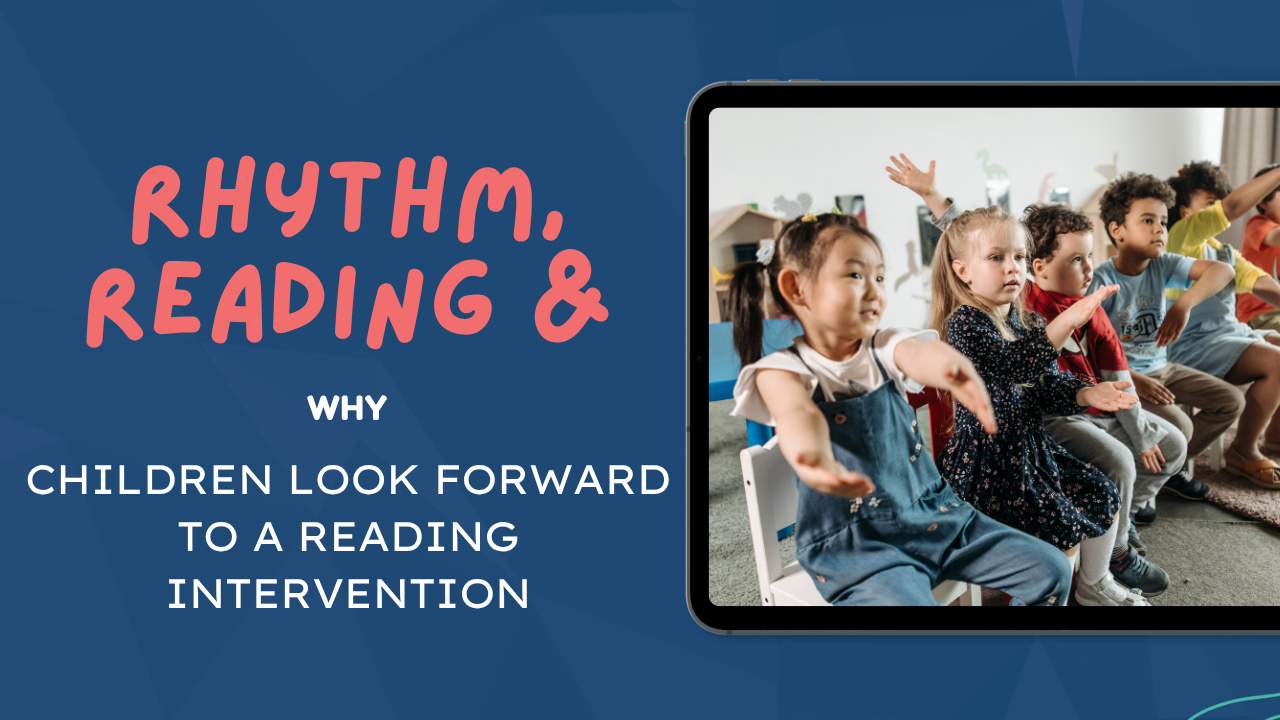
When the year two children skipped into the room in week three of Rhythm for Reading, they were already smiling. As soon as they sat down they started chanting one of the rhymes that we use as a warm-up: “Do we look at the blobs? Yes, Yes, Yes. Do we look at the sticks? No, No, NO!” They collapsed into giggles after the ‘No’s’ and restarted the rhyme louder each time. The teachers in the room were chuckling as their energy was infectious. This was only the start of the session and the irrepressible joy grew with every minute and continued to build week after week. Although this is typical of what rhythm can do, I’m not suggesting that every group behaves like this. Some children are much more reserved and we use this rhyme to establish that they are comfortable joining in during the first three sessions of the programme. Even when children are reserved, they still convey joy. We see children’s faces relax, their breathing settle into a deeper rhythm and their eyes twinkling as they smile during the audio clips. We can then record at the end of the session that they were joining in all of the time, but in their own quieter way.
“The children do really look forward to the sessions because they don’t necessarily see it as reading. They see it as something fun that they do and they don’t really realise the impact that it’s having on their reading.” LKS2 Phase Leader, London
The upbeat feelings of joy and fun were not what I’d intended when I built this programme. Of course, discovering that it had such positive side-effects was lovely. Over the years, I’ve noted with interest that children who make the most progress in reading comprehension have been those who’d enjoyed it the most and I wondered what was going on. I pondered whether motivation was driving the gains in reading, or whether they were starting from a different baseline in some undefined aspect of how they perceived themselves as mattering or belonging.
Togetherness and belonging
Belonging sits at the foundation of teamwork and togetherness. Rhythm is precise and we build synchrony with that precision. Through synchrony, high quality teamwork and togetherness accumulate in every minute of the programme. Imagine for a moment walking into a room and seeing this in action. The children are focused, concentrating on producing a joint sound, and moving together in time with music that has been written to support this process.
They are locked together by entrainment which is a natural phenomenon that shapes collective movement. Flocks of birds such as starlings, and shoals of fish such as mackerel are the best known examples of this. The human equivalent is synchronised singing and chanting. For example, in football stands, supporters sing and chant together, building momentum and positivity for the players. And for thousands of years synchronised drilled formations have been key for building precision, bonding and discipline in military units. Rhythmic drumming and melodies played on the fife (a type of flute) helped with building morale, discipline and precision during training and when on the march.
Nowadays in schools, group singing or recitation of verse take place in assembly or in the end of term ‘production’, and when video clips are posted online it is obvious that some children are not in time with others. Even if they have learned all the words of the songs, they may still stray either ahead or behind their classmates, due to a lack of sensitivity to rhythm. And even if they have memorised their lines, they may deliver them in a flat tone of voice. This too is related to rhythm because the differences in rhythmic stress and syllable length provide grammatical cues. These point to the syntax, meaning and the expressive qualities of the utterances.
School leaders may not even realise that the end of term production is such a valuable assessment tool. To a trained eye, these clips show children at very different levels of rhythmic sensitivity. Most schools don’t realise how much that clip reveals, or how much those children could do with a structured rhythm-based intervention in place.
After three to five weeks of rhythm-based sessions, sensitivity to rhythm improves and children find they are able to stay in time with others (even on the stage), follow what is happening around them (including in lessons) and read aloud with expression, because the syntactic and semantic elements of language have become clearer. For some children the sharpness that develops with improved sensitivity to rhythm clicks into place in an instant, and for others it builds slowly over a longer period of six weeks.
Reading this you may well wonder what the teacher must do differently to realise
a new level of precision,
a new sensitivity to rhythm,
the expressive qualities in reading,
the snapping together of grammatical cues with extracting meaning from the words,
the clarity of the phonemes in listening and in the voice?
The answer to this long question is: less than you might expect.
The music has been written to a brief to hold the children’s attention and to structure their listening so that precision and sensitivity develop during the weekly sessions. Teachers play an important role in maintaining the ethos of inclusion, belonging and positivity in every session which is demanding, especially whilst chanting and moving with the children. But, because the music captivates the children, and holds their attention, teachers are not managing behaviour as much as usual.
The pull of the rhythmic structure
Let’s think for a moment about a pendulum. It swings one way and then the other. Many aspects of life follow this principle. Consider walking - one foot then the other, arms swinging one way and then the other. Children enjoying the swings at the park or in a garden experience the principle of the to and the fro as a wondrous sense of momentum, gravity and symmetry all at once. If we zoom out and think about tidal patterns or waves breaking on a beach, the to and the fro is playing out once again. If we zoom in, we find the same pendulum in our inhale and exhale. Some of these rhythmic patterns hold our attention, whereas others do not because they are working in the background all of the time.
In speech patterns, we take turns in conversations. An answer follows a question, and in a sentence, a predicate follows a subject. The pendulum swings in the way we expect that the first part of a sentence is completed by the most probable second part. The anticipation of this to and fro movement in language can involve symmetry but is most likely to present as asymmetry, especially in prose. Each sentence takes on its own length and shape, depending to a large extent on what came before it. Sensitivity to rhythm in language enables children to detect and anticipate the most probable completion of a sentence.
In music it’s possible to build sensitivity to rhythm because each phrase length is regular, which helps children to anticipate the musical structures. There are no words to recall, so the focus is entirely on fluency and rhythmic precision. The structure is built on the principle of simplicity, so that teachers do not need prior musical experience to deliver the sessions with confidence. And the most important principle in delivering the programme is steadiness. The goal of the CPD programme is to empower the teachers to teach and learn at the same time and a co-teaching video resource guide is available so that in the first phase of the 30-week CPD programme teachers internalise the routines and structure of the sessions as they deliver them.
What the CPD costs in time and money
This is a 30-week CPD training. During the first 10-weeks of CPD, teachers co-teach with the video resources and for this reason the weekly sessions are 30-minutes long. The intervention takes 300 minutes in total, across the 10 weeks of term one. In the second term, the sessions are 20 minutes long and in the third term, they are 10 minutes in length.
At the end of the 30-week programme, teachers are able to deliver Rhythm for Reading in 10 minutes per week and to make small adaptations for SEND children, having mastered all of the principles during the training.
To support teachers, planning and progress are discussed in a weekly fifteen-minute one-to-one mentoring session with the programme developer. The teachers also have a reflection tool and they can bring their reflections to the session, as teacher wellbeing is the first priority of the CPD programme. All of these are included in the training at £295 per teacher, in line with the standard rate for a single day of CPD.
Where to start
On Thursday at 6PM UK time, you’re invited to join a webinar about reading fluency where we will track reading fluency together in real time, using the free Reading Fluency Tracker.
Join the reading fluency webinar.
Download a free reading fluency Tracker
FAQs
Do I need any musical training?
No. Musical training is not needed to deliver the programme. If teachers enjoy music in their own way that is helpful. This might look like singing along with a playlist, dancing in the kitchen at home.
Although the CPD does involve reading musical notation, this is a skill that teachers and children pick up in only a few minutes. The musical resources are designed so that children who are struggling with the alphabetic principle are supported. For example, children and students in special schools have found the notation in the programme is actually easier for them than reading a simple word such as ‘cat’.
In Twilight INSET sessions, when an entire school team has taken part, they too have learned to read simple musical notation with fluency and actions in only five minutes and they laughed afterwards. It was always the intention that reading musical notation would be an enabler rather than a barrier to learning.
What does a session actually look like?
All the sessions can look very similar but each one moves towards the next step in a universal framework for the entire programme. Children develop synchrony with one another and build belonging, togetherness and teamwork using their voices and simple physical actions. They also learn to read simple musical notation. The sessions begin with simple tasks and these build in complexity week by week. They revisit familiar routines and music each week, but also add a new layer of challenge. By the end of the ten weeks they can read in time with a minimum of seven short pieces of music.
Ten minutes doesn’t sound like very much. Why is it enough?
When we talk about children practising reading with an adult at home, ten minutes can be a realistic target. However, for lower-attaining readers, who may have fragile attention, a ten-minute session may feel like a long period of time at first, but it is also an appropriate amount of time for building their focus in an intensive way.
We’d expect ten minutes of planks or crunches once a week to have an impact. One hundred minutes of intense core-training is not trivial and neither is rhythm-based training.
Lastly, a shorter session which leaves the children ‘wanting more’, is effective in building momentum and motivation from week to week.
Why are sessions 30-minutes in the training, but only 10 minutes afterwards?
The 30-minute training sessions involve hearing me model the instructions at a particular pace so that the style of delivery, and the specific sequence of the tasks can be absorbed through repetition by the teacher. This lightens the load for the teacher, because there’s no memorising involved, the learning happens in an intuitive and natural way and the videos have been designed to be fun and upbeat to deliver.
The pace of delivery matters a great deal, so working through the videos and repeating the tasks week after week ensures that the teacher is able to flow from task to task in a fast-paced way at the end of the 30-week training and to deliver the 10-minute sessions with insight and confidence at the end of the CPD programme.
Who delivers the sessions?
Members of the teaching team deliver the sessions. The programme is only available to schools supporting children’s reading in a regulated and professional setting.
What if a session doesn’t go well?
Sessions vary in terms of their quality for many reasons. Most of these can be avoided by taking steps to check timetables and equipment in advance.
For example, if children have been taken out of class while their classmates are watching a video, or practising an end of term production, the session will not go well because the children will perceive they are missing out on something precious..
If there are technical issues with the equipment because a software update is required, the resources will not stream into the room.
If a child is upset perhaps because they were punished for their behaviour earlier in the school day, their subdued energy can ripple out across the entire group and affect learning.
The weekly mentoring sessions provide teachers with an opportunity to address these issues and anything else that has affected the session.
Can I try something before committing?
Yes. On Thursday you are welcome to join a webinar where you will see how a session is structured, and we’ll work on tracking reading fluency together. Lastly, there’s a relaxed question and answer session. Join the reading fluency webinar.